
When managing public spaces, municipal parks, or neighborhood pathways, we frequently encounter small but persistent water flows across pedestrian walkways. Rather than a sudden storm surge, these localized, steady flows often originate from minor structural gaps, grading issues, or adjacent irrigation systems.
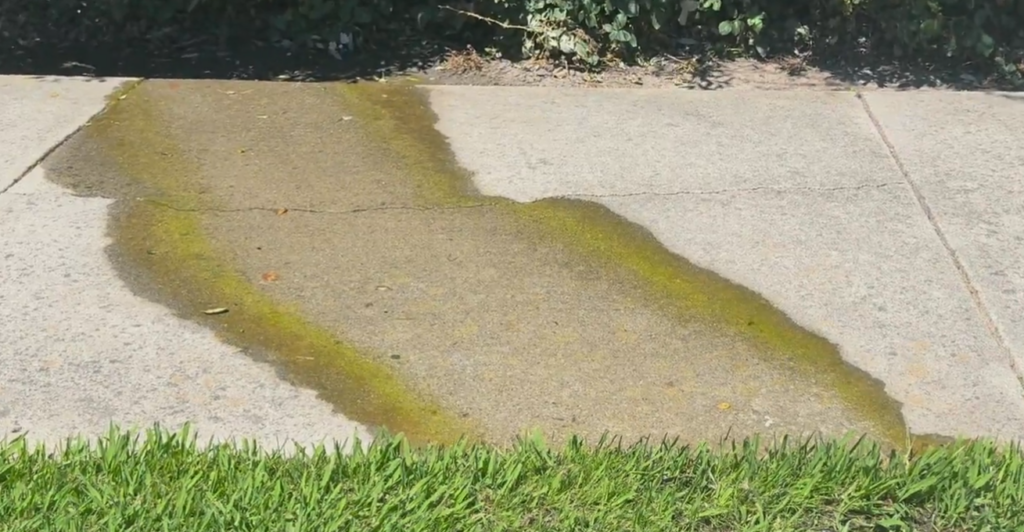
A clear example of this can be seen along a common park pathway, where water consistently seeps out of the nearby landscape, flows across the concrete, and saturates the adjacent turf.
Naming the Pattern: Persistent Base Flow and Algae Growth
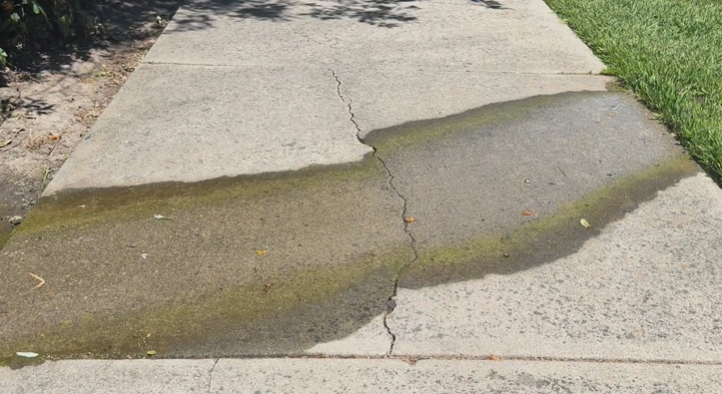
When a walkway experiences steady, thin sheets of water over an extended period, it alters the local surface condition. Because the concrete remains continuously damp, a distinct green band of algae develops directly within the water path. This is a common environmental response to constant moisture, creating a highly visible marker of where the water regularly moves.
In this specific area, the water emerges from the dense vegetation and soil layer bordering the uphill side of the path. It exploits a structural crack in the concrete walkway to follow the path of least resistance, cutting directly across the pedestrian path before pooling into the lawn below.
Understanding the Contributing Factors
Observing these water patterns highlights several intersecting infrastructure dynamics:
Subsurface and Lateral Seepage: Water frequently accumulates behind low retaining edges or vegetative borders due to overwatering, minor pipe leaks, or natural shallow groundwater movement. Once the soil saturates, the excess water pushes laterally toward lower elevations.
• Grading and Structural Intersections: Concrete panels act as a barrier to shallow horizontal water movement. When a crack forms, or when the adjacent landscape grading is slightly higher than the pavement surface, the water inevitably spills across the hardscape rather than remaining contained within a subterranean or designated drainage system.
• Surface Saturation: On the downhill side of the sidewalk, the continuous discharge saturates the soil beneath the grass. Over time, this constant saturation can stress local turf species, muddy the area, and cause localized soil compaction or shifting.
Navigating Constraints and Practical Outcomes
In municipal and civil infrastructure management, addressing every localized seepage point involves balancing clear trade-offs. Minor, non-structural flows are often monitored rather than immediately excavated, as full remediation can require extensive regrading, installing French drains, or retrofitting sub-surface drainage lines.
Recognizing these patterns early allows operations and maintenance teams to track whether a flow remains stable or indicates an escalating issue, supporting sound, long-term decision-making for public assets.
▶️ Watch here
Learn more about Watearth at our homepage.