
Have you ever wondered how wildlife survives in urban environments?
On a recent walk near a concrete flood control channel, two geese became the center of attention. Traffic noise, hard infrastructure, and the pace of the surrounding city faded into the background for a moment while the birds moved through the channel, honking at each other and pecking through vegetation growing along the water’s edge.
The setting itself was not pristine.
The channel water appeared murky, with visible algae growth and accumulated sediment. Urban runoff likely carries metals, nutrients, bacteria, and other pollutants through the system. Flood control channels are typically engineered for conveyance and public safety, not habitat creation. Yet wildlife still finds ways to occupy these spaces.
That contrast is difficult to ignore.
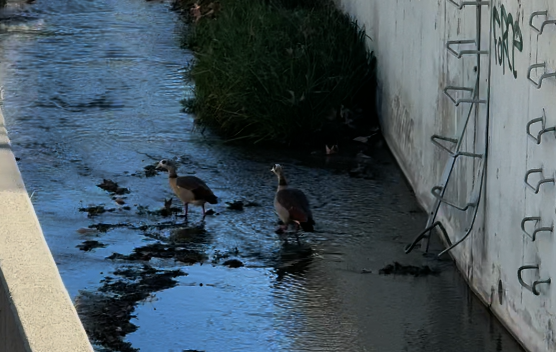
Concrete-lined channels are often viewed only as infrastructure. The purpose is flood management, emergency access, and stormwater movement. Features like maintenance ramps, ladders, and access steps exist for operational needs, not ecological comfort. Still, vegetation establishes itself along edges and low-flow areas. Insects gather where plant growth persists. Birds adapt behavior around those patterns.
The geese repeatedly pecked through the vegetation, likely searching for insects or food sources supported by the small ecosystem developing within the channel corridor.
Urban systems frequently create unintended environmental relationships.
Some of those relationships reveal stress within the environment. Others reveal resilience.
Wildlife presence does not necessarily mean conditions are healthy. Adaptation should not be confused with ideal habitat conditions. At the same time, these observations demonstrate how living systems continue responding to available opportunities, even within highly modified environments.
That may be part of why moments like this feel grounding during urban walks.
Animals moving through infrastructure corridors can briefly shift attention away from traffic, schedules, and built surroundings. Observing wildlife in unexpected places often creates a reminder that environmental systems continue operating around and within human systems at all times.
Not perfectly. Not without constraints.
But persistently.
In many urban waterways, vegetation, insects, birds, runoff, infrastructure, erosion, and maintenance operations all interact simultaneously. These environments are rarely simple. Observing those interactions without immediately forcing conclusions can still be valuable.
Sometimes the observation itself is enough.
▶️ Watch here
Learn more about Watearth at our homepage.